From new structures to genuine collaboration:
A success story with Structogram

“Over 20 years’ experience as a senior communications and Structogram trainer, having worked with thousands of enthusiastic participants from the fields of sales and leadership, is your guarantee of success with the STRUCTOGRAM® training system.
Achieve your goals faster and more easily thanks to people skills!”

‘The Structogram has proved particularly helpful, especially in my team, where 90 per cent of the staff are new recruits. It has enabled us to get to know one another better and to strengthen collaboration across our various sites.’

Greater collaboration through Structogram
With the transformation of Suva’s claims management, the organisation in the Eastern Region also underwent a fundamental change. Suddenly, in some cases, entirely new teams, new roles and new leadership structures emerged. One thing was immediately apparent:
The structure was in place – but the sense of teamwork still had to develop.
People who had never worked together before were expected to function as a well-coordinated team overnight. Different working styles, expectations and uncertainties collided. Behind the façade of the new organisation, a key question arose:
How can we turn this into a genuine team? How can the new organisation be made operational as quickly as possible – not just structurally, but above all in human and cultural terms?
This is precisely where the Structogram came in. The training was deliberately designed to do more than simply teach methods. It was intended to provide guidance, foster understanding and lay the foundations for collaboration. The aim was for managers and staff to recognise why people tick differently – and exactly how this can be a strength.
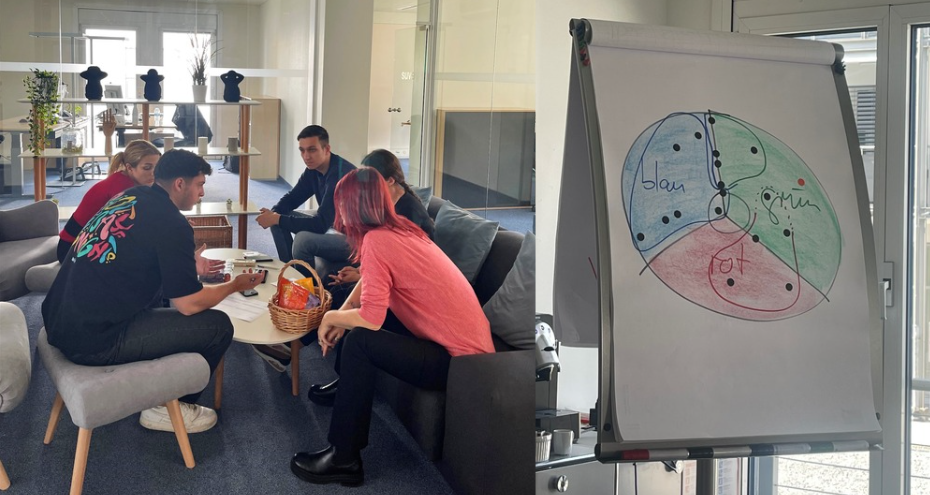
What began as a traditional workshop quickly developed into a shared experience. Away from day-to-day business, there was space for discussion, reflection – and even a bit of humour. “An all-round successful day: the team was motivated, there was plenty of laughter, and the playful approach created a pleasantly relaxed atmosphere.”
The varied and engaging programme was largely down to the course leader, Kurt Klaus. “Despite some initial scepticism, Kurt Klaus managed to engage the staff effectively, win them over, and make it fun.”
With every exercise, mutual understanding grew. Suddenly, seemingly difficult behaviours made sense. Reactions that had previously been irritating became understandable.
“After the Structogram training, many staff members said: ‘Ah, now I understand why you always do it that way.’3
These moments were crucial: Uncertainty gave way to clarity; hasty judgements gave way to genuine understanding. Differences were no longer seen as obstacles, but as valuable contributions to the team.
In day-to-day life, it soon became clear just how lasting the impact of these insights was. Conversations were conducted more thoughtfully, tasks were allocated in a more targeted manner, and leadership was tailored more to the individual. Tensions eased because people no longer took behaviour personally. Instead, a common language emerged, which is still present within the team today.
“We can now better understand each individual’s behaviour – a major advantage for our day-to-day collaboration.”
Managers were able to respond more effectively to needs, staff felt better understood, and trust within the teams grew noticeably. In this way, a formal reorganisation gradually evolved into a functioning, vibrant team culture.
The feedback regarding recommendations for Structogram to Ralph Sutter, Regional Head of Claims Management at Suva Region East, was unanimously positive. “Structogram proved particularly helpful, especially in my team, where 90 per cent of staff are new recruits. It enabled us to get to know one another better and to strengthen collaboration across different sites.”
Conclusion: Structogram has not only imparted knowledge, but also forged connections.
It has helped teams to find their feet more quickly, understand one another better and work together effectively – especially when everything is new.
Suva has been a cornerstone of the Swiss social security system since 1918. As part of the unique Suva model, it combines prevention, insurance and rehabilitation under one roof. It protects people from accidents and occupational diseases, provides financial security for accident victims and supports their recovery and reintegration.
As a non-profit organisation, Suva returns financial surpluses to its insured members in the form of lower premiums, thereby creating sustainable added value for individuals, businesses and the Swiss economy.
Interpersonal skills can be learnt
The Structogram visualises a person’s personal biostructure and highlights individual strengths, weaknesses and areas for development. The aim is to develop authentically and in harmony with one’s own nature. At the same time, participants learn to recognise the biostructures of others more effectively, to understand their behaviour and to communicate more constructively.
The method is non-judgemental and reveals established personality patterns.