Anyone who leads, develops or supports people knows that success stems from understanding. This is precisely where STRUCTOGRAM® comes in. With a clear focus on self-awareness, scientifically grounded analysis and practical applications, the method reveals what defines personalities – and how collaboration can be made more effective. The Golden Circle shows why STRUCTOGRAM® works, how it works and what concrete solutions it offers.
The Structogram is a widely used method for improving communication between staff, within management teams and in customer relations. This training system is used in numerous sectors and organisations. It is successfully applied in both small organisations, such as doctors’ surgeries, and large international corporations.
A clear and concise presentation of the analysis results.
A simple and immediate practical application of the knowledge acquired by the participants!
A scientifically based model of personality – supported by the latest findings in neuroscience, behavioural genetics and molecular biology.
Distinction between ‘trait’ (an unchangeable, genetically determined underlying structure of personality) and ‘state’ (changeable behavioural characteristics influenced by the environment).
Exceptionally high test–retest reliability – measured over a period of up to 13 years, with values consistently above ‘90’ – and thus high stability over time and reliability of the results.
Structogram is the common language within the company. And it’s available in 21 languages worldwide.
Essential personality traits depend on the individual functioning of the brain.
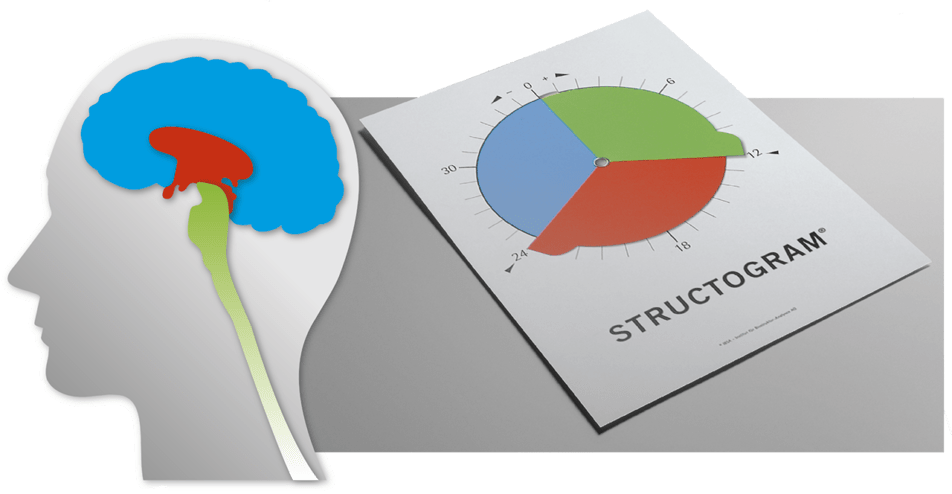
Renowned American brain researcher Professor Dr. Paul D. MacLean has demonstrated that the human brain consists of three areas that perform different functions (functional structure of the brain). These three very different brains must nevertheless work together and communicate with each other in the „triune brain.” However, each brain retains its own specific rules.
Human behavior arises only from the interaction of the emotional-instinctive brain stem, the emotional-impulsive diencephalon, and the rational-cool cerebrum.
Every person has a unique, genetically determined balance of influence among the three brains, which remains constant in adults. This is their individual biostructure.
In collaboration with MacLean, the anthropologist Rolf W. Schirm has, through biostructural analysis, identified and defined typical personality traits and behaviors that are clearly linked to the three brains. A set of questions derived from this analysis, designed to determine the relative influence of the three brains on an individual, is addressed in the seminar and visually represented using the Structogram.
The following color-coding system has proven effective:
The individual activity levels of the three brain regions are influenced by specific biochemical processes, particularly neurotransmitters (neurotransmitter homeostasis).
A key feature of biostructure analysis is the distinction between genetically determined, stable personality traits and environmentally influenced, malleable characteristics. This makes it clear which behaviors can be changed in the long term and which are based on a permanent biological foundation
The Structogram does not represent a rigid typology. Due to the design of the biostructural analysis, there are a total of 7,558,272 selection variants, leading to 412 different possible outcomes on the Structogram disc. Thus, the Structogram represents the individual interplay of the three brain regions in a highly differentiated scale.
Further information on the scientific foundations and background of biostructure analysis can be found in the reference volume: Evolution of Personality – The Foundations of Biostructure Analysis
With the STRUCTOGRAM® training system, you'll quickly and easily learn to communicate on a wavelength that your customers can understand.
Sustained Sales Success
Customers are all different. They have different motivations and needs. Successful salespeople understand these and use that understanding to develop the most effective sales pitches or the right offer.
Practice Makes Perfect
Reading and understanding customer needs takes practice. With the Structogram, we focus on three key steps.
1 Self-awareness.
Knowing your own strengths, limitations, and weaknesses helps you consciously choose the right sales methods and techniques.
2 Customer understanding.
Through systematic observation, we recognize the personality structure of other people. Recognizing a customer’s uniqueness and adjusting one’s own expectations form the basis for a successful sales conversation.
3 Product knowledge.
Product value only arises when the product’s features align with the customer’s needs. The features are systematically analyzed and matched to the corresponding customer profile.
People are different, and the ability to respond to these differences is crucial to our success in day-to-day leadership. Leadership is not a matter of position, title, or status, but primarily a matter of personality.
Understanding the key motivations of different personality types helps you determine the right approach or leadership method and find the “right” words even in difficult situations.
Employees are not “difficult,” just different.
These are the three training steps to your success!
1 Self-awareness.
Understanding your own strengths, limitations, and weaknesses helps you better comprehend your own motivations, impulses, and expectations and regulate them purposefully.
2 Understanding others.
Through systematic observation, we recognize the personality structures of others. Acknowledging the differences in others and adjusting our own expectations accordingly becomes a leadership tool.
3 Project knowledge.
Relating the requirements of the task to the individuality of each employee builds trust.
Just as not every shoe size fits everyone, communication does not follow a one-size-fits-all approach. In our daily work as leaders, salespeople, and team members, we are constantly challenged to connect with people who think and act differently.
Successful leadership, sales, or collaboration is less a matter of title and position—and more a matter of personality. Those who understand the core motivations of different personality types communicate more clearly, lead more effectively, and find the right words even in challenging situations.
Those who understand people’s individuality are more successful.
How do you make decisions, for example? Select two statements.
Find more information on our free app: Structogram
The STRUCTOGRAM® training system (biostructural analysis) was developed based on findings from brain research and is strongly supported by current research in the fields of anthropology and systems science.
The American neuroscientist Professor Dr. Paul D. MacLean, Director of the Institute for “Brain Evolution and Behavior” at the “National Institute of Mental Health” in Bethesda, Maryland, researched the evolutionary biological foundations and mechanisms of action (“functional structure”) of the brain in the 1970s and 1980s. In doing so, he discovered that our brain has retained the essential features from different eras of evolution in its development. MacLean coined the term “Triune Brain” (“three-in-one brain”) to describe this. His discovery contributes significantly to our understanding of the connections between brain structure and human nature and behavior.
The consulting anthropologist Rolf W. Schirm, Munich, had developed a model of human personality based on a multitude of empirical studies. These empirical findings were refined and solidified as a structural model and given a firm scientific foundation through MacLean’s “Triune Brain Concept,” which Schirm first encountered in the 1970s. This led to the development of Biostructure Analysis with the Structogram.
Swiss Dr. Victor Bataillard, a founding member of the Swiss Institute of Business Administration and former owner of Organisator-Verlag in Zurich, also founded the Institute for Biostructure Analysis AG (IBSA) in Zurich in collaboration with Schirm, serving as the international franchisor for Biostructure Analysis. Following the death of Dr. Bataillard, Swiss national Peter Stutz took over the leadership of the institute. Today we are based in Bern, and since April 2025, Marc Pfister has been steering the operational business of IBSA.
After the turn of the millennium, the scientific foundations of Biostructure Analysis were expanded. This was based on new findings in the anthropological disciplines and the systems sciences. Among other things, it became clear that specific neurotransmitters are responsible for the different “activity levels” of the three brain regions (neurotransmitter homeostasis).
The team of authors Christian Reist, Ralf China, and Peter Stutz has, after several years of work, further developed and modernized the practical application of the Structogram training system for leadership and sales.